4.9/5 from 800+ Canadians  ·  Read Google reviews
🏆 CPA Self-Accredited Printer #1010

CPA Cheque Standards in Canada: Standard 006 Explained

The full Canadian cheque spec: CPA Standard 006 dimensions, MICR clear band, image-capture rules, and CPA Self-Accredited Printer #1010 accreditation.
✓ Physical dimensions ✓ MICR clear band ✓ Image-capture rules ✓ Printer accreditation
See CPA-Compliant Cheques →
Questions about the spec? Call 1-866-760-2661
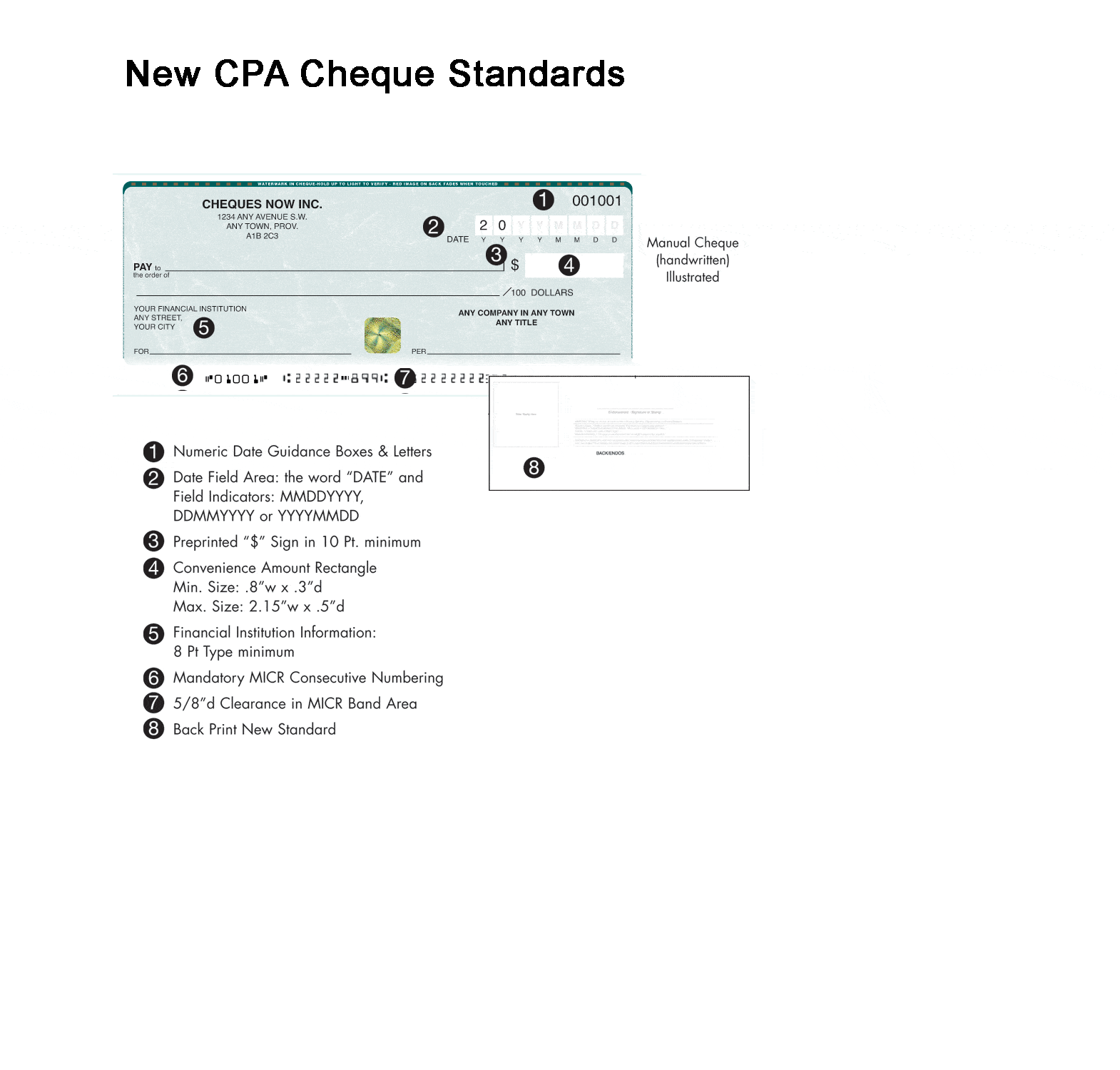
CPA Standard 006 cheque specification: minimum 6 1/4 inch length, bottom 5/8 inch MICR clear band, and E-13B MICR line placement

CPA cheque standards is the industry shorthand for Standard 006, the cheque specification that Payments Canada publishes and enforces across Canadian banks. Payments Canada is the only current name for the certifying body; “CPA” is the abbreviation still used in search and in everyday industry language.

Standard 006 covers the physical dimensions, MICR (Magnetic Ink Character Recognition) encoding, and image-capture rules a cheque must meet to clear through the Canadian banking system without manual intervention.

What Is Standard 006?

Standard 006 is the Payments Canada specification that defines how a Canadian cheque must be built and printed so it can be processed automatically. Payments Canada is the national organization that certifies cheque printers in Canada and maintains the standard.

This page covers the physical and image-capture requirements: paper stock, print contrast, field placement, and the MICR line.

Scope: Standard 006 governs cheques cleared through the Canadian banking system. It does not apply to American checks.

Physical Requirements of a Compliant Canadian Cheque

A compliant cheque has to meet fixed rules for length, the MICR clear band, and where each field sits on the page. Here’s what each of those requirements covers.

Minimum Length

A compliant Canadian cheque must be at least 6¼ inches (15.88 cm) long, per Payments Canada’s cheque guidance. That’s longer than the older 6-inch minimum, extended specifically to fit the mandatory MICR serial number without crowding the clear band.

A cheque printed shorter than this can force the serial number too close to other printed fields, which is one of the more common reasons in-house print jobs fail on the first pass.

The MICR Clear Band and E-13B

Standard 006 reserves the bottom 5/8 inch of the cheque, the MICR clear band, for the MICR line only. Inside that 5/8-inch band, the MICR line itself sits in a 1/4-inch print band, with roughly 3/16 inch of clearance above and below it. E-13B is the font used to encode that line: a 14-character set covering digits 0 through 9 plus four field-separator symbols.

No signature, logo, border, or background design can cross into the clear band. Blank laser cheque stock is manufactured with the MICR band pre-printed to this spec, so the printer only has to lay down the variable data, not manage clear-band placement itself.

For a field-by-field look at where the MICR line sits on a printed cheque, see the cheque-anatomy walkthrough.

Protected Field Layout

Standard 006 fixes the position of each protected field, the date, payee, amount, signature, and member institution information, so they sit in the same place on every cheque built to spec.

Moving a field outside its zone can cause a bank’s reader-sorter (the automated equipment that scans and routes cheques during clearing) to misread or reject the item, even when the printed data itself is correct.

Standard 006 physical and image-capture requirements
Attribute Requirement
Minimum cheque length 6¼" (15.88 cm)
MICR clear band Bottom 5/8" of the cheque
MICR print band (within clear band) 1/4", with ~3/16" clearance above and below
MICR font E-13B
Minimum PCS (print contrast signal, image capture) 0.60

Image-Capture Compliance

Image-capture compliance means a cheque prints with enough contrast and a clean enough layout for a bank’s imaging system to read it without manual review. The minimum PCS for a compliant cheque is 0.60, according to Payments Canada’s guidance.

PCS measures how well the printed characters stand out from the background; a cheque that falls below that threshold risks rejection during automated image capture even if a person can read it fine.

Design Choices That Break Image Capture

A handful of design choices push a cheque below that threshold or otherwise interfere with image capture:

  • Inverse printing (light text on a dark fill)
  • Italic or slanted fonts in protected fields
  • A border printed directly under the MICR line
  • Dark or heavily patterned backgrounds
  • Security features placed over an area of interest, such as the signature line or amount box

Any one of these can force a cheque into manual review, which slows down deposit and increases handling cost on both sides of the transaction.

Date Field Rules

Standard 006 accepts three numeric date formats, per Payments Canada’s guidance: MMDDYYYY, DDMMYYYY, and YYYYMMDD, along with their French equivalents. Whichever format a cheque uses, a short format indicator must print directly below the date line so the reader, human or automated, knows how to parse it.

These field positions stay fixed across Print & Cheques Now’s business cheque formats, so accounting-software output lines up with the protected date and field layout instead of drifting from run to run.

What Happens If a Cheque Doesn’t Meet Standard 006

A cheque that fails Standard 006 gets pulled out of automated processing and has to be handled by hand. That typically shows up as one or more of the following:

  • Rejection by the reader-sorter during automated clearing
  • Delays while the item moves to manual processing
  • Manual-processing fees charged by the receiving institution
  • A hold placed on the funds until the item clears

These outcomes trace back to a single root cause: something in the physical layout, MICR line, or image contrast fell outside spec, so the automated system couldn’t process the cheque with confidence.

Accreditation

Who Can Print Compliant Cheques in Canada

Payments Canada runs the Cheque Printer Self Accreditation Program: a printer certifies its own equipment and processes against Standard 006, without needing separate outside certification for every print run. Approximately 20 printers across Canada currently hold this self-accredited status.

To verify a printer’s accreditation before ordering from them:

1

Find the stated number

Check the printer’s own site for a stated CPA Self-Accredited Printer number.

2

Cross-reference the directory

Cross-reference that number against Payments Canada’s printer directory.

3

Confirm it’s active

Confirm the listing is active, not a lapsed or historical credential.

Print & Cheques Now and Standard 006: Printer #1010

Print & Cheques Now holds CPA Self-Accredited Printer #1010 status through Payments Canada’s Cheque Printer Self Accreditation Program, one of approximately 20 printers in Canada certified this way. Every cheque produced under that credential is built to the specification covered above: correct length, clear band, field layout, and image-capture contrast.

Every cheque ordered under that credential is backed by the Bank Acceptance Guarantee: if a Canadian bank rejects it, Print & Cheques Now reprints or refunds it. For the full breakdown of what CPA accreditation means for the cheques you order, see CPA-compliant cheques. Order at chequesnow.ca or call 1-866-760-2661.

Our Commitment

Two Guarantees on Every Order

Accuracy Guarantee

If there is ever a printing error on your order, Print & Cheques Now corrects and reprints your cheques at no additional cost.

🏢

Bank Acceptance Guarantee

Every cheque is built to Payments Canada Standard 006 under CPA Self-Accredited Printer #1010. If a Canadian bank rejects one, Print & Cheques Now reprints or refunds it.

FAQ

FAQ: CPA Cheque Standards

Do all Canadian business cheques need to be CPA compliant?
Yes. Standard 006 applies to any cheque cleared through Canada’s banking system, whether it’s a personal cheque, a business cheque, or a manually written one. A cheque that doesn’t meet it gets pulled into manual processing instead of clearing automatically.
What is the minimum cheque length under Standard 006?
6¼ inches (15.88 cm). That’s the minimum length needed to fit the mandatory MICR serial number without crowding the clear band.
What is the minimum PCS for a compliant cheque?
The minimum is 0.60 PCS. Print contrast signal (PCS) measures how well the printed characters stand out from the background for automated image capture, and a cheque printed below 0.60 PCS risks rejection even if the text reads clearly to a person.
Is “CPA 2006” the same as Standard 006?
Industry usage treats “CPA 2006” as referring to the same Standard 006 requirements covered on this page, not a separate specification. See the CPA-compliant cheques page for how Print & Cheques Now meets it.
How do I verify a printer’s accreditation?
Check the printer’s stated CPA Self-Accredited Printer number and cross-reference it against Payments Canada’s printer directory to confirm the credential is active.
Can I print my own compliant cheques?
You can, but every print run has to independently meet the length, clear band, MICR font, and PCS requirements above. Laser cheque stock built to spec removes most of that risk, since the clear band and MICR positioning are pre-printed and only the variable data changes per run.
🏆CPA Self-Accredited Printer #1010: one of ~20 in Canada

Order Cheques Built to Standard 006

Correct length, clear band, field layout, and image-capture contrast on every order, backed by the Bank Acceptance Guarantee.

Canadian support  ·  chequesnow.ca